K-8th Grade Open Houses:
Friday, November 13th
Friday, January 22nd
Early Learning Open House:
Tuesday, February 23rd

.png)
Friday, November 13th
Friday, January 22nd
Tuesday, February 23rd
OPEN HOUSE | Friday, November 13th | RSVP TODAY

Northshore Christian Academy filters all learning and curriculum through a Biblical worldview. We endeavor to train students spiritually, academically, and personally. Northshore integrates faith and learning as we equip each child to successfully impact the world using their God-given talents and abilities.
The students will learn a chronological study of Genesis through Joshua. In addition, the Gospels and Acts will be studied with emphasis on Christmas and Easter. Also, students will study how Jesus sets us free to serve and obey. The Bible stories are shared through pictures and the ACSI curriculum.
Weekly Bible memorization. Verses apply to our Bible stories for that week.
Emphasis is on students’ involvement in singing in a weekly worship environment, with exposure to practical Christian truths through guest speakers and character quality awards.
Self-contained. Basic skill areas.
Computers, Library, PE, Music, Engineering – Project Lead the Way, Art, Science Lab
At Northshore Christian Academy in the 2nd Grade Department, our students are blessed with incredible educators who have ACSI accreditation and/or have their Washington State Teaching Certificates. Our teachers feel called to be exemplary educators and come from diverse and prominent teaching backgrounds that equip them with the tools necessary to meet the needs of each of our students.
As a Christian school, located in Everett, WA, we have the pleasure of partnering with families, local schools, and businesses to give our students a well-rounded education. Our program focuses not only on the exemplary academics and the spiritual development of each student but also on their social and emotional development. Our program diligently works to support each of our students in their scholarly and personal endeavors as it helps shape and mold them into thriving members of our community.
Through collaborative teamwork, facilitated by our Professional Learning Community (PLC), our teachers are able to create an environment of dynamically different teaching styles and a strategically consistent curriculum. This allows our teachers to successfully impact our students by supporting all different learning styles. Northshore’s teamwork approach in evaluating data, such as our standardized testing, helps our program continue to be at the forefront of producing students ready to lead the world.
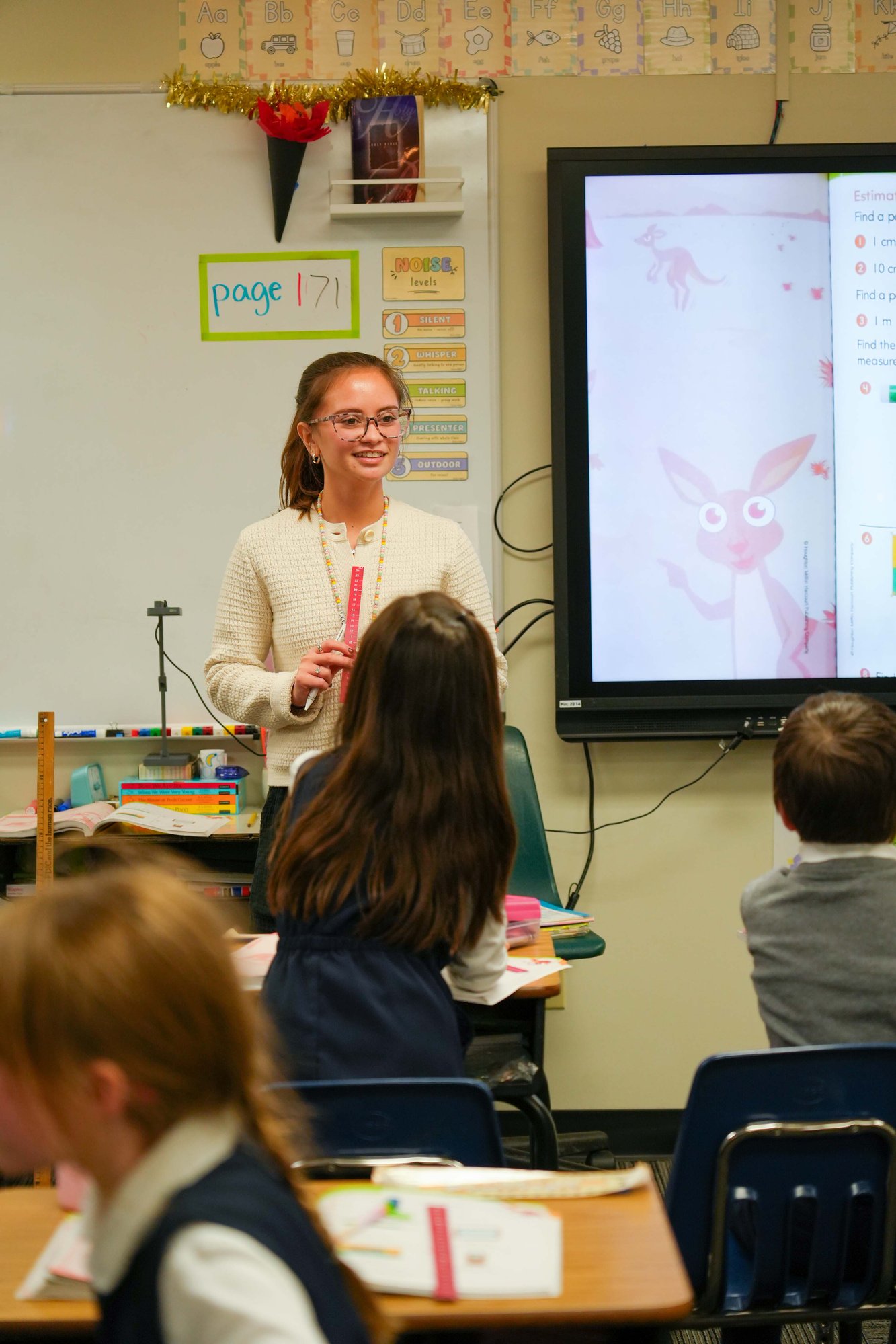
Students learn the elements of written communication so that they can begin to express themselves in an effective manner. Students write opinion pieces, informational texts, and narrative texts with appropriate structure and detail. Students use correct punctuation, capitalization, and complete sentences to make their writing clear and understandable. Students select an appropriate, interesting idea to carry through a story, compare/contrast written pieces that use ordinary versus exciting word choice, edit and write with the correct organization, have a beginning, middle, and end, and recognize the terms sentence fluency and voice through hearing and discussing pieces that possess these qualities. Students also learn and write paragraphs with correct structure (topic sentences, four supporting details, and closing sentences).
Students develop proper handwriting skills for effective written communication and presentation. Handwriting is evaluated by size, slant, shape, spacing, and position.
Students learn and apply rules and conventions in order to build on and improve their written and oral communication skills. Content will include sentences, capitalization, and punctuation, among other things. Students will also be able to build upon phonic sounds and reading foundational skills in order to read with accuracy and fluency to support comprehension.
Students improve spelling skills through an emphasis on phonetic features and spelling patterns. Spelling skills are connected to sorting, phonics, reading, writing, and editing. Spelling is evaluated on dictation tests, standardized tests, and correct use in writing.
Students learn and practice mental math or “automaticity of” (fluency in) math facts, and all mathematical skills with daily practice and weekly assessments using Math Expressions where skills are reviewed regularly and built on in manageable increments.
Students learn about the four main facets of history from a Biblical Worldview: social, political, economic, and religious. By learning about these important historical areas, students will expand their awareness of the world around them.
Bible: NIV Bible
Reading/Language Arts: Amplify CKLA
Writing: Amplify CKLA
Math: Math Expressions
Social Studies: Heritage Studies (Bob Jones)
Science: SAVVAS
We strive to provide our students with current software applications relevant to their lives that integrate all areas of our school curriculum. The focus of computers in second grade is to touch on computer ethics from a Christian perspective and to develop problem-solving techniques as well as the ability to integrate computers into all areas of the curriculum. Second graders will be introduced to initial typing techniques and word processing. Students will also be introduced to the Internet and safe searching techniques.
Students learn about book care, title and copyright, table of contents, book index, and illustration pages.
Grade 2 General Music is a year-long class meeting two times per week for 30 minutes where we explore all aspects of music through listening, singing, reading, movement, and playing a variety of instruments. In second grade, the use of both rhythm and pitched instruments are used to explore the elements of music. Throughout the year, students learn musical concepts, vocabulary, singing skills, and performance skills. They are exposed to a variety of musical genres. Students are encouraged to use music as a form of communication in expressing their thoughts and feelings. Students are encouraged that music can be a powerful tool to communicate with God and about God. They are encouraged to develop their skills in order to do that more effectively and to bring honor and glory to God by doing it to the best of their abilities.
The students learn teamwork and sportsmanship and participate in a variety of athletic activities to facilitate the development of motor skills, coordination, and physical fitness. Skill development is emphasized throughout the year in various common games or sports: soccer, basketball, modified volleyball, hockey, tumbling, etc.
Students study a variety of famous artists each year. The students study the artist’s artwork and techniques that have made their artwork world-renowned. Students learn art theory and techniques through hands-on art projects that build art skills using various mediums.
Project Lead the Way (PLTW) is the leading provider of rigorous and innovative Science, Technology, Engineering, and Mathematics (STEM) education curricular programs used in elementary, middle, and high schools across the U.S. The program is set up in modules that follow the design process. Each 10-hour module is aligned to grade-level standards and incorporates the process of hands-on engineering. In second grade, students investigate and classify different kinds of materials by their observable properties. After testing materials and analyzing the data, the students determine the best material to build a box that will keep popsicles frozen. Using the design process, students will also design and build a seed-dispersing machine in module 2. The four 10-hour modules students complete are (1) Materials Science: Properties of Matter, (2) Form and Function, (3) The changing Earth, and (4) Grids and Games.
Imagine Children's Museum, Fossil and Dinosaur Exploration
Christmas, Parade of Historical Figures Performance
Presenting the 2nd Grade Parade of Historical Figures, Heritage Family Project & Feast, Chapter Books
Watch DOGS Dads, Speech Meet, Missions Month, Walk-a-Thon, Moments with Mom, Veterans Day Chapel, Field Day.
Promethean Board, document camera, educational software and apps, classroom audio systems, and interactive learning subscriptions such as BrainPOP and Boost Reading.
.png?width=2000&name=NCA%20LOGO%20MASTER%20-%20reversed%20-%20062821%20(10).png)